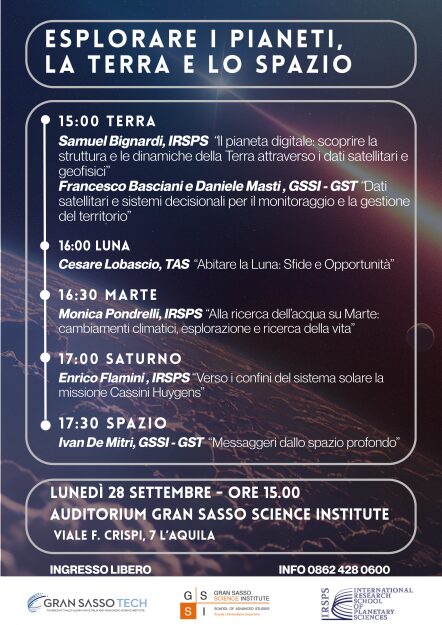
What can we discover about the Earth through data collected by satellites? What is needed to envisage a permanent presence on the Moon? And how is our knowledge of the Moon, Mars and Saturn changing thanks to space missions and new technologies? These are some of the topics at the heart of “Exploring Planets, Earth and Space”, the public event dedicated to planetary science scheduled for Monday 28 September in L’Aquila, at the Auditorium of the Rectorate of the Gran Sasso Science Institute, from 3:00 p.m. to 6:00 p.m.
The initiative is organised by Fondazione Gran Sasso Tech, Gran Sasso Science Institute and the International Research School of Planetary Sciences and offers an afternoon of science communication aimed at the general public and the university community. Researchers and specialists will discuss the frontiers of space exploration, starting with Earth and moving on to the colonization of the Moon, the search for water on Mars, and missions to other planets and deep space: different topics united by data, observations, and advanced technologies.
The Programme. At 3:00 p.m., the event will begin with the Earth, with Samuel Bignardi of the International Research School of Planetary Sciences, who will speak on “The Digital Planet: Discovering the Structure and Dynamics of the Earth through Satellite and Geophysical Data”, illustrating how the integration of data from satellites and geophysical observations makes it possible to study the structure and the processes affecting the planet. This will be followed by Francesco Basciani and Daniele Masti, from GSSI and Fondazione Gran Sasso Tech, who will address the topic of “Satellite Data and Decision-Making Systems for Territorial Monitoring and Management”, focusing on the use of Earth observation technologies to support the analysis and management of the territory and its emergencies, including forest fires.
At 4:00 p.m., attention will turn to the Moon, with Cesare Lobascio of Thales Alenia Space and his talk “Living on the Moon: Challenges and Opportunities”, which will illustrate the prospects associated with human presence on the lunar surface and the technological and operational issues involved in establishing a permanent settlement.
At 4:30 p.m., it will be the turn of Mars. Monica Pondrelli, from the International Research School of Planetary Sciences, will speak on “In Search of Water on Mars: Climate Change, Exploration and the Search for Life”. Water, the planet’s climate history and exploration missions will be at the centre of a talk that connects the study of the Martian environment with one of the main questions in planetary research: understanding whether, and under what conditions, Mars may have hosted, or may still preserve traces of, life.
The programme will continue at 5:00 p.m. with Saturn and the Cassini-Huygens mission, presented by Enrico Flamini of IRSPS in the talk “Towards the Boundaries of the Solar System: the Cassini Huygens Mission”. The mission, the result of collaboration between NASA, ESA and the Italian Space Agency, made it possible to collect an unprecedented amount of data on Saturn, its rings and its satellites, making a significant contribution to our knowledge of the outer planetary system.
Enrico Flamini, former Chief Scientist of ASI, was the project manager of the Cassini-Huygens mission.
Finally, at 5:30 p.m., the journey will move beyond the planets with Ivan De Mitri, from GSSI and Fondazione Gran Sasso Tech, who will present “Messengers from Deep Space”. The talk will focus on particles and radiation reaching the Earth from the most remote regions of space and on the information they can provide about the astrophysical phenomena that generated them.
An afternoon designed to communicate research beyond specialist environments, starting from the questions that underpin our understanding of the worlds around us.
The event is scheduled to conclude at 6:00 p.m.
The event is scheduled to conclude at 6:00 p.m. Participation is open to the public.